
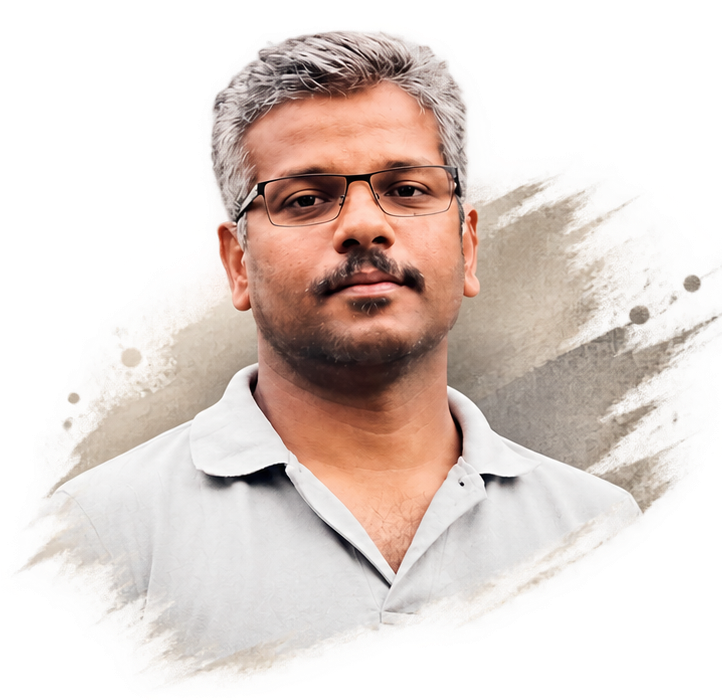

An Interview with SAYANTHAN by ANNOGEN, editor of Akazh magazine ; Translated by JEGADEESH KUMAR
Originally published in vishnupuramusa.org

Original Tamil interview அச்சமும், தப்பியோடும் விருப்பும் மரியாதைக்குரியது : சயந்தன்(Tamil online magazine, Akazh, Jan 2026)
Sayanthan is an Eelam Tamil writer. Through his novels Aaravadu, Aathirai, and Ashera—key works of Eelam war literature—he gained wide recognition among readers. Saynthan lives in Switzerland.
Annogen: Aaravadu came out, and a few years later Aathirai appeared. After a considerable gap came Ashera, and then, after another long stretch, Thisai Onbadhu. The intervals between your novels are always quite large. How do these in‑between periods pass for you? What kind of difficulties do you face as a writer during those stretches?
Sayanthan: Not just novels, my writing in general tends to have long gaps. After writing the short story Pooranam in 2019, I still haven’t written another short story. Even between novels, there’s almost a five‑year gap. But I don’t really face “difficulties” in those intervals. I don’t romanticize writing to the extent of saying I stagger around unable to put down the burden on my head, or that I write in the agony of creation.
So why do I write? Because I like writing. That’s all. I write in the way I enjoy writing. If readers enjoy it too, I’m happy. And it’s not just writing, every kind of literary activity appeals to me. When I’m not writing, I’m doing something of that sort. I read. I’m interested in translations, especially African writing. These days I enjoy taking Tamil works into Sinhalese. I publish Sinhalese books. And if nothing else, at the very least I’ll fiddle with the layout design of the Agazh website, poke at something like a busybody. That too is a kind of literary activity, isn’t it? I said five years between novels, that includes the writing period. Aathirai took three years. Thisai Onbadhu took two. Looking at it that way, I’m a bit slow. But that’s not a big problem, is it?
Annogen: Each of your novels uses a different language‑texture. The lively register of Aaravadu isn’t there in Aathirai. Ashera is different again. In Thisai Onbadhu, one can sense the style of Aaravadu returning. Does the theme choose the language? Or do you find themes to suit the language? Put simply, do you move toward the form, or does the form move toward you?
Sayanthan: I should say, this fellow may look innocent, but… You know very well that mockery, teasing, sarcasm, irony, and counter‑jokes are my natural mode. In Aaravadu that came out beautifully. Because Aaravadu was written through external events, without touching or probing the inner lives of the characters, that language fits well. Back then I didn’t know that the thoughts that ripple through the mind in the split second before a gun barrel touches the forehead could be written for ten pages without shrinking.
Then came Aathirai, a vast tragedy. When telling the stories of the oppressed, the marginalized, you can’t joke and play. It wouldn’t be ethical. Ashera too is the story of warped minds. Though there are dark jokes here and there, the language is intense.
When Thisai Onbadhu began to gather as a story, when the events it wove began to spread in imagination, it felt like a less intense, slightly mischievous language would suffice. Though there is a tightness somewhere deep inside, Thisai Onbadhu is not a story of great sorrow or sharp pain. At the same time, it is a story where the mind wanders for ten pages between the moment a gun barrel is raised and the moment it touches the forehead.
These days, leaving aside external events and moving closer to examine human minds feels exciting. I’ve developed an interest in investigating the characters’ brains with my writing, like a detective. In another sense, after Aathirai and Ashera, I wanted to write a story where no bomb explodes. That too is why I wrote Thisai Onbadhu. To answer your question, the theme chooses the language. And the differences in language, form, and technique from novel to novel give each one its own distinctiveness.
Annoge: How did the core of Thisai Onbadhu form? What kind of preparation did you do to expand its scope?
Sayanthan: The novel began with a chance encounter with a Tamil youth. Even before that, my mind kept nudging me, what if I wrote a story set outside Sri Lanka? I tried that in Ashera, but despite my plan it drifted back to Eelam.
So that accidental meeting sketched a complete story‑map outside Sri Lanka within me. I began writing. After that I did the preparations the writing demanded, mostly geographical. Then, global geographies and historical sufferings that had no direct link to the story’s core began to connect naturally. That was important.
Annogen: In Aathirai, the landscape descriptions were filled with fine, precise observations, trees, plants, birds. Thisai Onbadhu moves entirely through Europe. Was it difficult to bring the same precision here?
Sayanthan: I’m glad you noticed that about Aathirai. Writing a known landscape and writing an unknown one, both have challenges. There will be gaps. Filling those gaps with imagination is what makes one a fiction writer. That’s how I wrote about Ukraine and Russia. Writing cold and darkness as two accompanying characters in the novel was not difficult for me at all. Because here, in Europe, those two exist as daily curses that slowly kill me. And writing about an unfamiliar landscape has an advantage: We must carve that land within us before shaping it in our imagination.
When I wrote Aaravadu, a critic said, “In Alaveddy, the place you mention doesn’t have a wall, there’s only a fence.” To persuade someone through words a wall once stood in Alaveddy, especially if they’ve never been there, that is the power of fiction.
Annogen: The protagonist crosses so many obstacles to migrate. Can we reduce his reason to simply an aspect of his national identity?
Sayanthan: We give many reasons for migration, war, fear for life, things like that. But if you think about it, even without any of that, someone might migrate simply because, “I want to live a life I like. That’s all.” Just as an engineer migrates, just as a doctor migrates, why shouldn’t anyone else desire to migrate? There’s nothing wrong with that. The story is about how national identity influences such a desire.
Annogen: Contemporary Eelam novels often rely on remembrance. They begin ten years away from the present or unfold at a distance from the contemporary moment. Thisai Onbadhu is set in the present. It touches many layers, global right‑wing resurgence, anti‑immigrant sentiment, attitudes toward refugees. What’s most striking is how the novel shows that even though we group people under “refugees,” the reception changes depending on which country they come from and what color they are. This feels like the novel’s central conflict. Do you agree?
Sayanthan: I can agree. But at the most fundamental level, human fear and the desire to escape are worthy of respect. They must be honored. We must not only sing stories of child heroes, but of adult cowards as well. We can draw a line where the European mindset (regarding the refugee issue) stands in the way of their escape.
Annogen: Eelam novels are often judged as individual chapters of one large novel. They even end up fitting that mold. How does one tell a story beyond that challenge?
Sayanthan: Personally, I do want to step outside that. After writing Aathirai, I felt that strongly. That’s one thing. But Eelam writers don’t need to feel ashamed when asked, “How long are you going to keep writing about the Eelam war?” As long as there are sorrows that haven’t been cried out fully, crimes without justice, there will be stories that cannot be finished telling. “Try living that life yourself,” might come out as a writer’s anger or as a plea. But it will come out.
Annogen: Your first novel is fifteen years old now. How do you understand literature today?
Sayanthan: I had been writing long before that novel. During the war, literature was introduced to us as: the Tigers are fighting a war, and stories, poems, plays, paintings are created to explain the justice of that war to the people. That’s how it appeared to us. Anyone who was ten years old in the nineties would have experienced this. Eezhanaatham and Velichcham taught us exactly that. It took me a long time to step out of that and understand literature differently. Only after that did I shed many hesitations. To give a small example of what I mean: in Ashera, the “Kandan Karunai massacre” carried out by the Tigers is described line by line. A friend asked, “Did you really write that?” I said, “Yes. If the writing demands it, I will write it.”
That is where I’ve arrived now.

கருத்துகள்